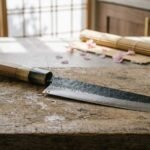
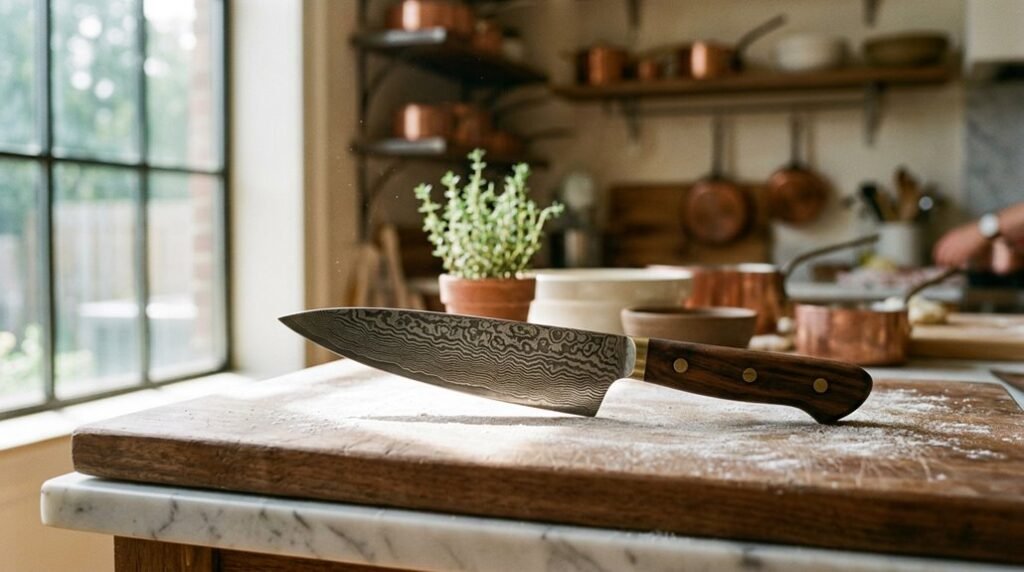
I’ve spent years watching home cooks struggle with knives that fight back, and here’s what I’ve learned: a blade should feel like an extension of your hand, not a tool you’re wrestling against. Miyabi gets this. Their Seki-forged knives combine centuries-old Japanese techniques with steels that actually hold an edge through serious prep work.
Whether you’re slicing delicate fish or breaking down a butternut squash, the right Miyabi transforms tedious tasks into something almost meditative. But not every line suits every cook, and choosing poorly means dropping serious money on a knife that collects dust.
The fifteen blades ahead solve specific problems, from the screaming-sharp SG2 core of the Mizu series to the forgiving, nimble geometry of the Koya. Some prioritize brute edge retention, others balance durability with everyday approachability, and a few simply demand to be displayed.
I’ll walk you through exactly which knife earns its place in your block, and why chefs quietly guard these recommendations.
| MIYABI Mizu SG2 Chef’s Knife (8-inch) | Best Overall | Blade Steel: SG2 micro-carbide powder stainless steel | Rockwell Hardness: 63 | Sharpening Method: Honbazuke (3-step) | VIEW LATEST PRICE | Read My Analysis | |
| Miyabi Birchwood SG2 8-inch Japanese Chef’s Knife | Premium Pick | Blade Steel: SG2 micro-carbide powder steel | Rockwell Hardness: Not specified | Sharpening Method: Honbazuke (3-step) | VIEW LATEST PRICE | Read My Analysis | |
| Miyabi Kaizen II 8-inch Chef’s Knife Stainless Steel | Best Value | Blade Steel: FC61 super steel | Rockwell Hardness: 61 | Sharpening Method: Honbazuke (4-step) | VIEW LATEST PRICE | Read My Analysis | |
| Miyabi Kaizen 8-Inch Chef’s Knife | Classic Choice | Blade Steel: VG10 super steel | Rockwell Hardness: 60 | Sharpening Method: Honbazuke (3-step) | VIEW LATEST PRICE | Read My Analysis | |
| MIYABI Koya 8-inch Chef’s Knife | Best Ergonomics | Blade Steel: FC61 fine carbide stainless steel | Rockwell Hardness: 61 | Sharpening Method: Hand-honed 12° double bevel | VIEW LATEST PRICE | Read My Analysis | |
| Miyabi Mizu SG2 Knife & Sharpener Set 4 Piece | Best Set Value | Blade Steel: SG2 micro-carbide powder stainless steel | Rockwell Hardness: 63 | Sharpening Method: Honbazuke (3-step) | VIEW LATEST PRICE | Read My Analysis | |
| Miyabi Koh 8-inch Chef’s Knife Stainless Steel | Best Workhorse | Blade Steel: FC61 fine carbide stainless steel | Rockwell Hardness: 61 | Sharpening Method: Honbazuke | VIEW LATEST PRICE | Read My Analysis | |
| Miyabi Mizu SG2 13 Piece Knife Block Set | Ultimate Set | Blade Steel: SG2 micro-carbide powder stainless steel | Rockwell Hardness: 63 | Sharpening Method: Honbazuke (3-step) | VIEW LATEST PRICE | Read My Analysis | |
| Miyabi Mizu SG2 Magnetic Easel Knife Set 10 Piece | Best Display Set | Blade Steel: SG2 micro-carbide powder stainless steel | Rockwell Hardness: 63 | Sharpening Method: Honbazuke (3-step) | VIEW LATEST PRICE | Read My Analysis | |
| Miyabi Kaizen II 3.5-inch Paring Knife | Best Paring Knife | Blade Steel: FC61 super steel | Rockwell Hardness: 61 | Sharpening Method: Honbazuke | VIEW LATEST PRICE | Read My Analysis | |
| Miyabi Kaizen II 6.5-inch Nakiri Knife Black Pakkawood Handle | Best Vegetable Knife | Blade Steel: FC61 super steel | Rockwell Hardness: 61 | Sharpening Method: Honbazuke (4-step) | VIEW LATEST PRICE | Read My Analysis | |
| Miyabi Evolution Chef’s Knife 8″ Stainless Steel | Best Hybrid Design | Blade Steel: FC61 fine carbide steel | Rockwell Hardness: Not specified (Friodurx2 ice-hardened) | Sharpening Method: Dry sharpened | VIEW LATEST PRICE | Read My Analysis | |
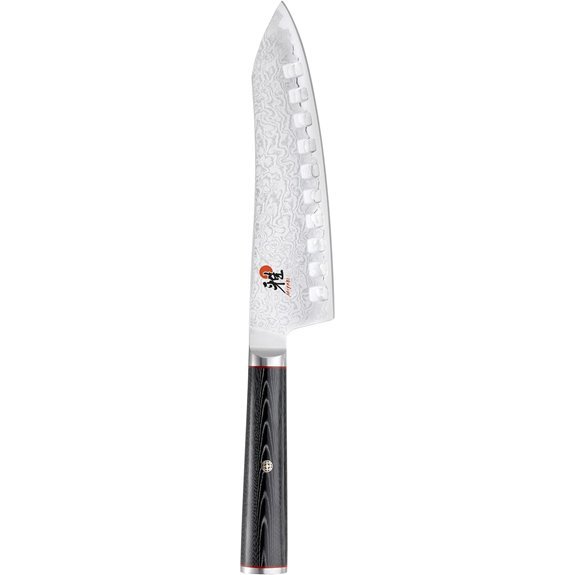
| MIYABI Kaizen 7-inch Hollow Edge Rocking Santoku Knife | Best Santoku | Blade Steel: VG10 super steel | Rockwell Hardness: 60 | Sharpening Method: Honbazuke (3-step) | VIEW LATEST PRICE | Read My Analysis | |
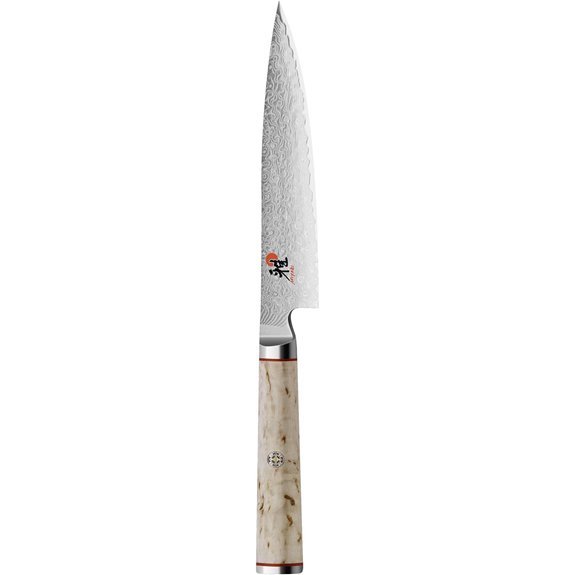
| Miyabi Paring/Utility Knife Stainless Steel 5-inch | Best Utility Knife | Blade Steel: G2 micro-carbide powder steel | Rockwell Hardness: Not specified | Sharpening Method: Honbazuke (3-step) | VIEW LATEST PRICE | Read My Analysis | |
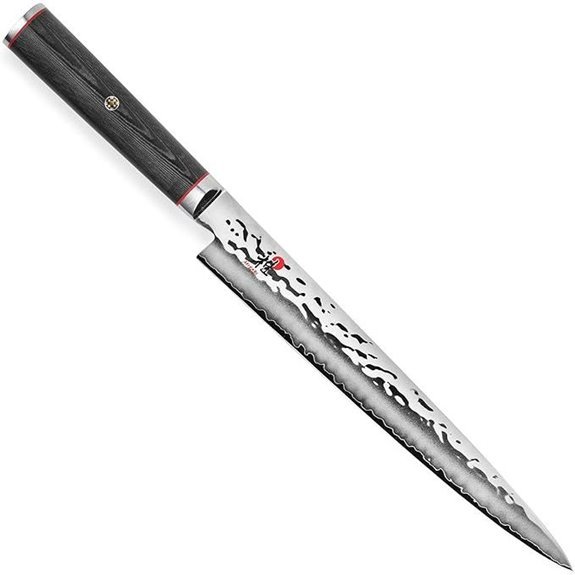
| MIYABI Mizu SG2 9.5″ Slicing Knife | Best Slicing Knife | Blade Steel: SG2 micro-carbide powder stainless steel | Rockwell Hardness: 63 | Sharpening Method: Honbazuke (3-step) | VIEW LATEST PRICE | Read My Analysis |
More Details on Our Top Picks
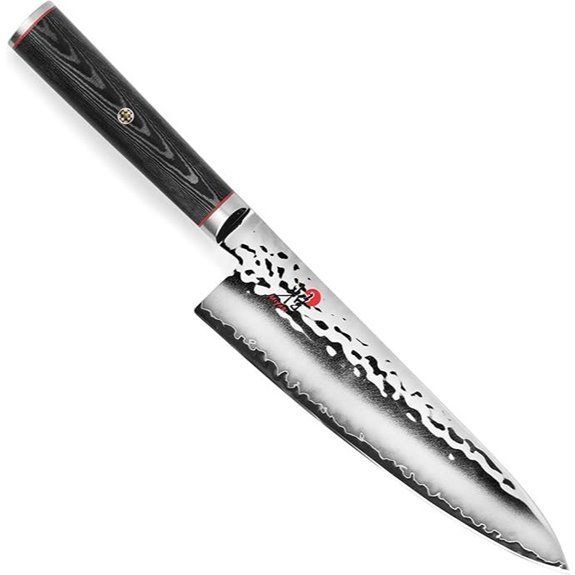
MIYABI Mizu SG2 Chef’s Knife (8-inch)
If you’re after one knife that’ll handle just about everything, I’d point you straight to the MIYABI Mizu SG2.
This 8-inch blade comes from Seki, Japan, where they’ve been making steel for centuries. The SG2 micro-carbide powder steel core gets wrapped in stainless and hammered into a Tsuchime Damascus pattern that looks eye-catching and helps food release.
They run it through Cryodur ice-hardening to hit 63 Rockwell hardness, which means serious edge retention without brittleness.
The honbazuke sharpening process is notable: whetstone sharpening twice, then mirror polishing on leather. You’ll get a 12-degree double bevel that’s razor sharp right out of the box.
The D-shaped Micarta handle feels balanced in hand, with a bolster and metal end cap, plus that decorative mosaic pin. At 0.46 pounds and 13.25 inches overall, it’s substantial without being heavy. Hand wash only, certainly.
- Blade Steel:SG2 micro-carbide powder stainless steel
- Rockwell Hardness:63
- Sharpening Method:Honbazuke (3-step)
- Edge Angle:12-degree double bevel
- Origin:Seki, Japan
- Dishwasher Safe:No
- Additional Feature:Hammered Tsuchime Damascus finish
- Additional Feature:D-shaped Micarta handle
- Additional Feature:Red spacer accents
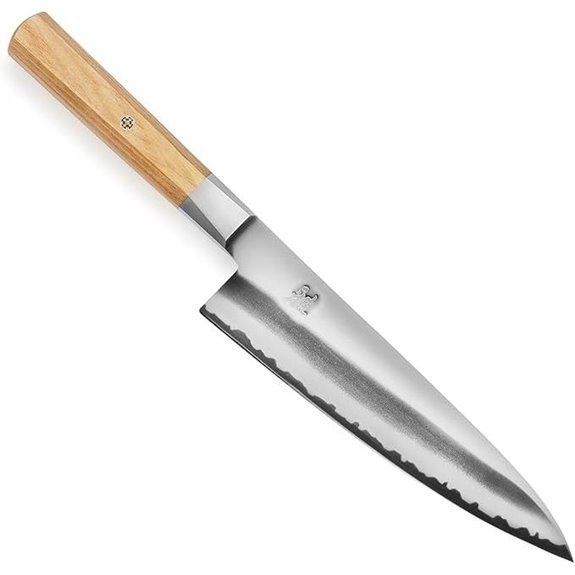
Miyabi Birchwood SG2 8-inch Japanese Chef’s Knife
You’re after something truly special, and this is my premium pick for anyone who wants heirloom-quality craftsmanship in their daily driver.
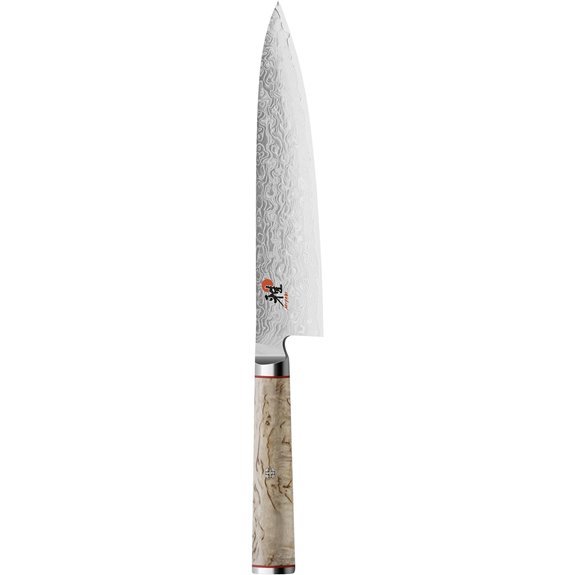
The Miyabi Birchwood SG2 8-inch Japanese Chef’s Knife brings genuine artistry to your cutting board.
Here’s what sets this blade apart:
- The steel: SG2 micro-carbide powder steel, ice-hardened through CRYODUR processing for lasting sharpness
- The edge: Hand-honed via three-step Honbazuke to a razor-sharp 9.5–12 degree angle
- The look: 100 layers create a striking flower Damascus pattern that isn’t just pretty, it adds durability
- The handle: Karelian Birch, the same prized wood used in Fabergé eggs, measuring 5.39 inches of ergonomic comfort
At 1.2 pounds with an 8-inch blade, it balances substantial heft with nimble precision.
Forged in Seki, Japan, this isn’t a knife you’ll toss in the dishwasher. Treat it with respect and it’ll outlast your kitchen.
But skip it if you’re rough on tools; this demands care.
- Blade Steel:SG2 micro-carbide powder steel
- Rockwell Hardness:Not specified
- Sharpening Method:Honbazuke (3-step)
- Edge Angle:9.5 to 12 degrees
- Origin:Seki, Japan
- Dishwasher Safe:No
- Additional Feature:Karelian Birchwood handle
- Additional Feature:100-layer flower Damascus
- Additional Feature:Fabergé egg wood
Miyabi Kaizen II 8-inch Chef’s Knife Stainless Steel
The Miyabi Kaizen II 8-inch Chef’s Knife delivers exceptional performance without the premium price tag of flagship models. I’ve watched this blade earn its place in serious home kitchens.
Here’s why it deserves your attention.
What makes the steel special:
- FC61 super steel core with fine carbide distribution for lasting sharpness
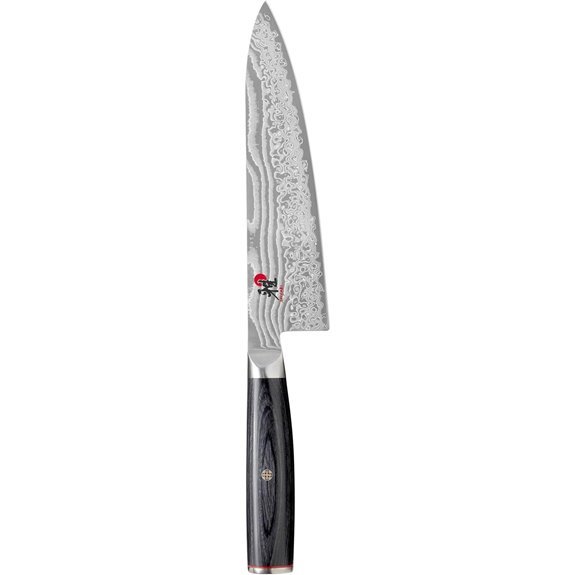
- 48 layers of Damascus cladding protecting that core
- Double ice-hardened FRIODUR treatment hits 61 Rockwell hardness
- Result: serious edge retention plus real corrosion resistance
The Honbazuke hand-honing method (that’s a traditional four-step Japanese technique) brings this edge down to 9.5-12 degrees. Translation: it slices like a dream.
The acid-dipped flower Damascus pattern looks remarkable, too.
Handling and specs:
At 7.04 ounces with a substantial D-shaped black pakkawood handle, it balances beautifully for extended prep sessions. The 14.75-inch overall length gives you proper knuckle clearance.
But the key point: hand wash only. No dishwasher shortcuts!
- Blade Steel:FC61 super steel
- Rockwell Hardness:61
- Sharpening Method:Honbazuke (4-step)
- Edge Angle:9.5 to 12 degrees
- Origin:Seki, Japan
- Dishwasher Safe:No
- Additional Feature:Acid-darkened Damascus pattern
- Additional Feature:Black pakkawood handle
- Additional Feature:Double ice-hardened FRIODUR
Miyabi Kaizen 8-Inch Chef’s Knife
Miyabi’s Kaizen 8-inch chef’s knife stands as a classic choice for cooks who want serious performance without jumping to the brand’s top tier.
I love how this knife brings legitimate Japanese craftsmanship to your counter. The VG10 super steel core gets ice-hardened to Rockwell 60, which basically means it’ll hold an edge through serious prep sessions.
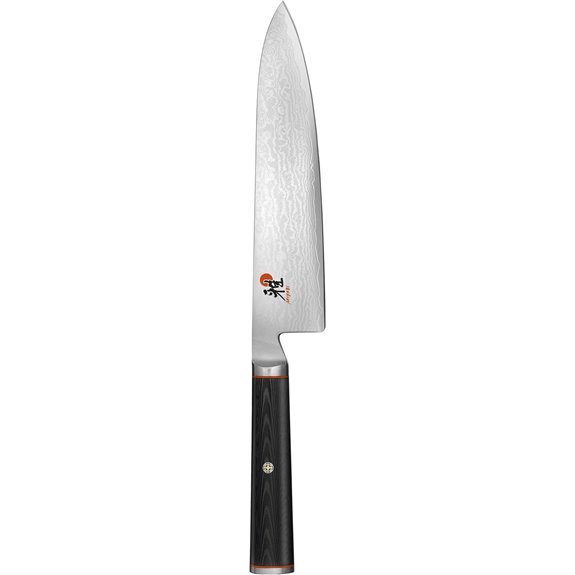
And that 65-layer flower Damascus pattern? It’s not just pretty; those layers protect that razor-sharp core.
The Honbazuke grind hits 9.5 to 12 degrees, so you’re getting genuine slicing aggression here. Seki artisans hand-hone each blade using a three-step process that’s been refined over centuries.
The Micarta handle feels like wood but laughs at moisture, and those red accent spacers add just enough visual pop. At 11.2 ounces, it’s balanced without being heavy.
One heads up: hand wash only. But with a lifetime warranty against defects, this knife’s built for the long haul.
- Blade Steel:VG10 super steel
- Rockwell Hardness:60
- Sharpening Method:Honbazuke (3-step)
- Edge Angle:9.5 to 12 degrees
- Origin:Seki, Japan
- Dishwasher Safe:No
- Additional Feature:65-layer flower Damascus
- Additional Feature:Red accent spacers
- Additional Feature:Black linen Micarta
MIYABI Koya 8-inch Chef’s Knife
If you value comfort as much as cutting prowess, I’ve found your match.
The MIYABI Koya 8-inch Chef’s Knife carries surprising desert lineage (“Koya” translates to “desert” in Japanese), yet it handles like an oasis for your hand.
Forty-six artisans in Seki, Japan’s legendary samurai sword-making capital, craft this blade through a meticulous 9-step finishing process.
Here’s what makes it unique:
- FC61 fine carbide stainless steel hardened to 61 Rockwell, giving you scalpel-like sharpness on a 12° double bevel edge
- Ice-hardened Friodur2 construction with sandblasted Katana edge finishing for serious durability
- Faceted birchwood pakkawood handle, individually weight-adjusted for your grip
The rounded spine, bolster, and heel eliminate fatigue during marathon prep sessions.
At 0.38 pounds, it pivots effortlessly between Western chopping and Eastern rocking cuts.
That mirror finish blade with hand-engraved logo? Gorgeous.
Just remember: hand-wash only, no dishwasher adventures!
- Blade Steel:FC61 fine carbide stainless steel
- Rockwell Hardness:61
- Sharpening Method:Hand-honed 12° double bevel
- Edge Angle:12° double bevel
- Origin:Seki, Japan
- Dishwasher Safe:No
- Additional Feature:Sandblasted Katana edge
- Additional Feature:Faceted birchwood pakkawood
- Additional Feature:9-step finishing process
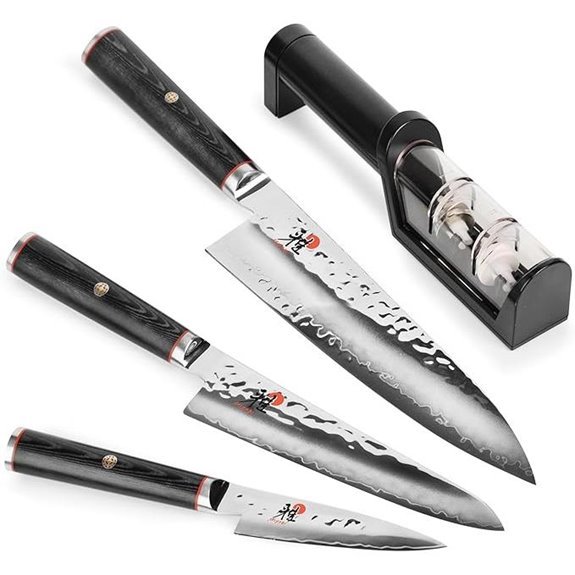
Miyabi Mizu SG2 Knife & Sharpener Set 4 Piece
Compact yet thorough, this set delivers serious performance without demanding serious space. It’s the best value entry point for anyone ready to step into premium Japanese cutlery.
You’ll get three workhorse blades plus a sharpener, which frankly solves the biggest headache most home cooks face: keeping knives actually sharp. The lineup covers your bases:
- 3.5″ paring knife for detail work
- 5.5″ prep knife for vegetables and herbs
- 8″ chef’s knife for everything else
- Miyabi Diamond/Ceramic dual-stage pull-through sharpener
The SG2 core steel hits 63 Rockwell, meaning serious edge retention paired with that forgiving flexibility you want for daily use. And that hammered Tsuchime finish? It’s not just pretty, it helps food release rather than sticking to the blade.
Each knife undergoes Honbazuke sharpening, a three-step process borrowed from samurai sword making: twice on whetstones, then mirror polishing on leather. The result is a 12-degree edge that’s genuinely razor sharp.
The D-shaped Micarta handle with its mosaic pin and red spacers feels balanced in hand, and the whole thing’s handmade in Seki, Japan. Four pounds total weight, limited lifetime warranty, and you’re cooking with confidence.
- Blade Steel:SG2 micro-carbide powder stainless steel
- Rockwell Hardness:63
- Sharpening Method:Honbazuke (3-step)
- Edge Angle:12-degree double bevel
- Origin:Seki, Japan
- Dishwasher Safe:No
- Additional Feature:Includes pull-through sharpener
- Additional Feature:Three-knife variety set
- Additional Feature:Diamond/ceramic sharpener
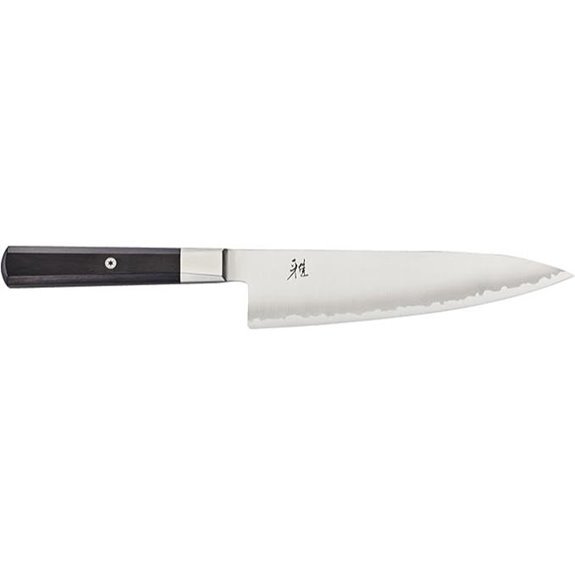
Miyabi Koh 8-inch Chef’s Knife Stainless Steel
The Koh 8-inch chef’s knife suits everyday home cooks who want one reliable blade for most kitchen tasks. I call it the workhorse that doesn’t quit, and here’s why it earns kitchen counter space.
What you’re holding:
- FC61 stainless steel — fine carbide steel hardened to 61 Rockwell, which means it keeps that edge through serious prep sessions
- FRIODURx2 ice-hardening — a double ice-hardening process that boosts durability and corrosion resistance so your investment lasts
- 9.5–12° edge angle — that razor-thin profile slices with minimal resistance, whether you’re mincing garlic or breaking down chicken
The blade’s stamped, not forged, but don’t let that fool you. Honbazuke hand-honing in Seki, Japan gives it legit katana-sharp credentials.
The sandblasted edge looks menacing and performs accordingly.
I’ve got mixed feelings on the pakkawood octagon handle — it’s beautiful with that silver mosaic pin, and it works for both rocking and chopping styles. But hand-wash only, no dishwasher shortcuts!
At 0.6 pounds, it’s nimble without feeling toy-like.
- Blade Steel:FC61 fine carbide stainless steel
- Rockwell Hardness:61
- Sharpening Method:Honbazuke
- Edge Angle:9.5–12°
- Origin:Seki, Japan
- Dishwasher Safe:No
- Additional Feature:Octagon-shaped pakkawood handle
- Additional Feature:Embossed MIYABI logo
- Additional Feature:True katana edge
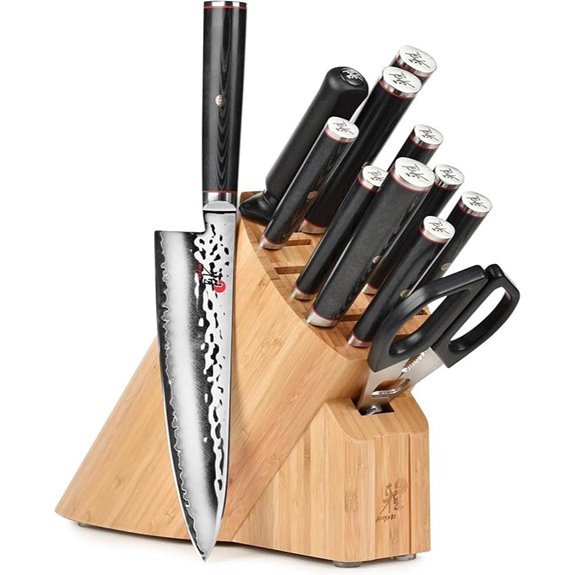
Miyabi Mizu SG2 13 Piece Knife Block Set
You’re stepping up to serious home cooking, and this is where I’d point you first. The Miyabi Mizu SG2 13 Piece Knife Block Set gives you everything you’d actually use, nothing you won’t.
Here’s what’s inside:
- 3.5″ Paring Knife
- 5.5″ Prep Knife
- 7″ Santoku Knife
- 8″ Chef’s Knife
- 9″ Bread Knife
- 9.5″ Slicing Knife
- Four 4.75″ Steak Knives
- 9″ Tungsten Sharpening Steel
- Kitchen Shears
- 12-slot Bamboo Knife Block
The SG2 micro-carbide powder steel core hits 63 Rockwell hardness, which means these blades stay sharp through serious use. The Cryodur ice-hardening and Honbazuke sharpening (that’s the three-step Japanese method: whetstone, whetstone, leather wheel) produces a 12-degree double bevel edge that slices like you wouldn’t believe.
I love the hammered Damascus finish, and that Micarta D-shape handle with its mosaic pin and red spacers feels balanced in your hand. Made in Seki, Japan, with a limited lifetime warranty. Hand wash only, clearly.
- Blade Steel:SG2 micro-carbide powder stainless steel
- Rockwell Hardness:63
- Sharpening Method:Honbazuke (3-step)
- Edge Angle:12-degree double bevel
- Origin:Seki, Japan
- Dishwasher Safe:No
- Additional Feature:12-slot bamboo block
- Additional Feature:Four steak knives included
- Additional Feature:Tungsten sharpening steel
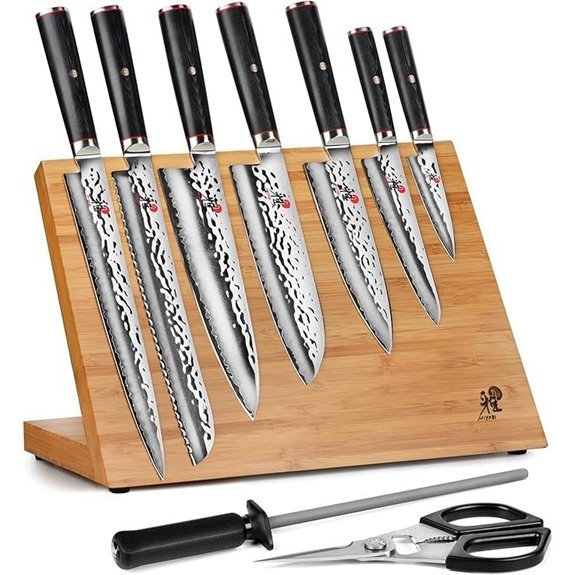
Miyabi Mizu SG2 Magnetic Easel Knife Set 10 Piece
Looking for a set that turns heads before you even slice?
The Miyabi Mizu SG2 Magnetic Easel Knife Set delivers serious theatre. That bamboo magnetic easel stand doesn’t just store blades, it showcases them like museum pieces, which, given what you’re getting, feels appropriate.
Here’s what lives on that wall:
- 3.5″ Paring Knife
- 5.5″ Prep Knife
- 6″ Chef’s Knife
- 7″ Santoku
- 8″ Chef’s Knife
- 9″ Bread Knife
- 9.5″ Slicing Knife
- 9″ Tungsten Sharpening Steel
- Kitchen Shears
Each blade carries SG2 micro-carbide powder steel wrapped in hammered Damascus, ice-hardened to 63 Rockwell. Translation: they’ll keep slicing long after lesser knives surrender.
The Honbazuke edge, that three-step samurai-derived sharpening ritual, leaves you with a 12-degree double bevel that glides rather than tears.
The Micarta D-shape handles feel substantial, balanced by that metal end cap, and yes, there’s a decorative mosaic pin because Miyabi knows presentation matters. Hand wash only, essentially. Made in Seki, Japan, with a limited lifetime warranty backing the craftsmanship.
- Blade Steel:SG2 micro-carbide powder stainless steel
- Rockwell Hardness:63
- Sharpening Method:Honbazuke (3-step)
- Edge Angle:12-degree double bevel
- Origin:Seki, Japan
- Dishwasher Safe:No
- Additional Feature:Bamboo magnetic easel stand
- Additional Feature:Ten-piece comprehensive set
- Additional Feature:Kitchen shears included
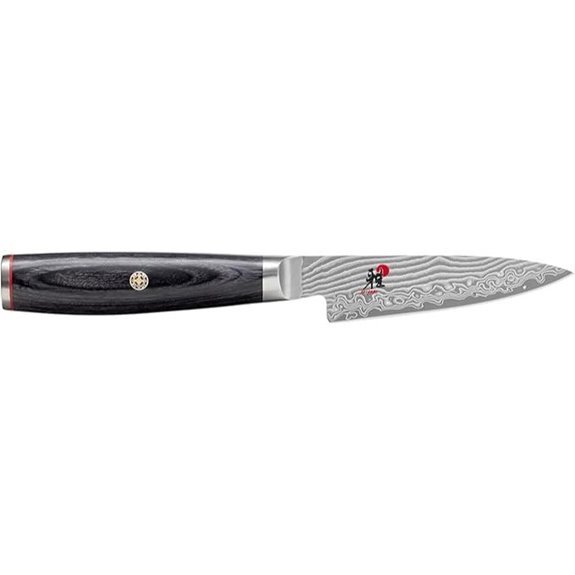
Miyabi Kaizen II 3.5-inch Paring Knife
Anyone who peels apples daily knows a paring knife earns its keep. I’ve found the Miyabi Kaizen II 3.5-inch Paring Knife stands ready for those small, precise tasks where larger blades fumble.
This little workhorse packs serious metallurgy. The FC61 super steel core, wrapped in 48 layers of stainless damascus, hits 61 Rockwell hardness after double ice-hardening. Translation: it stays sharp through mountains of shallots and citrus.
The hand-honed Honbazuke edge, angled between 9.5 and 12 degrees, glides through tomato skins like they were butter. What catches my eye is that flower damascus pattern, deepened through acid dipping. Pretty, yes, but the thin Japanese profile means business.
The black pakkawood D-handle fits naturally in my grip, and at 2.88 ounces, it won’t fatigue my hand during detailed work. Handcrafted in Seki, Japan, this forged blade demands hand washing only. Treat it right, and it’ll outlast lesser knives by years.
- Blade Steel:FC61 super steel
- Rockwell Hardness:61
- Sharpening Method:Honbazuke
- Edge Angle:9.5 to 12 degrees
- Origin:Seki, Japan
- Dishwasher Safe:No
- Additional Feature:Compact 3.5-inch blade
- Additional Feature:Lightweight 2.88 ounces
- Additional Feature:Essential kitchen tool
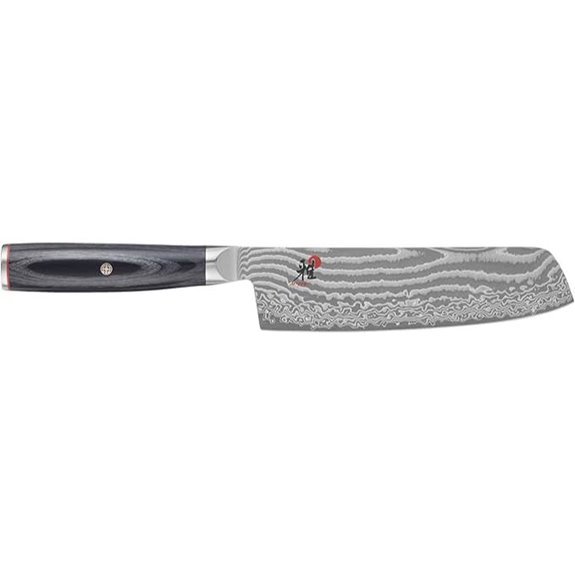
Miyabi Kaizen II 6.5-inch Nakiri Knife Black Pakkawood Handle
This Nakiri earns its place on my list for cooks who want a vegetable knife that actually feels purpose-built for the task.
I’ve watched too many home cooks struggle with chef’s knives on cabbage and butternut squash. The Kaizen II Nakiri solves this with a 6.5-inch rectangular blade profile designed for one thing: pushing straight down through vegetables without the rocking motion.
Here’s what makes it tick:
- FC61 super steel core (48 damascus layers wrapped around it) holds a 61 Rockwell hardness
- Double ice-hardened FRIODUR treatment means edge retention that outlasts typical stainless options
- 9.5 to 12 degree edge angle hand-honed via Honbazuke method, the same four-step technique used on swords
The 0.46-pound weight won’t fatigue you during meal prep marathons.
And that D-shaped pakkawood handle? Classic Japanese ergonomic thinking—your knuckles clear the board while your palm stays locked in.
Handcrafted in Seki, Japan, with the dark flower Damascus pattern from acid dipping. Not dishwasher safe, certainly. Respect the steel, hand wash it, and it rewards you.
It’s quietly winning over vegetable-forward cooks.
- Blade Steel:FC61 super steel
- Rockwell Hardness:61
- Sharpening Method:Honbazuke (4-step)
- Edge Angle:9.5 to 12 degrees
- Origin:Seki, Japan
- Dishwasher Safe:No
- Additional Feature:Nakiri vegetable knife
- Additional Feature:6.5-inch blade length
- Additional Feature:Usuba category leader
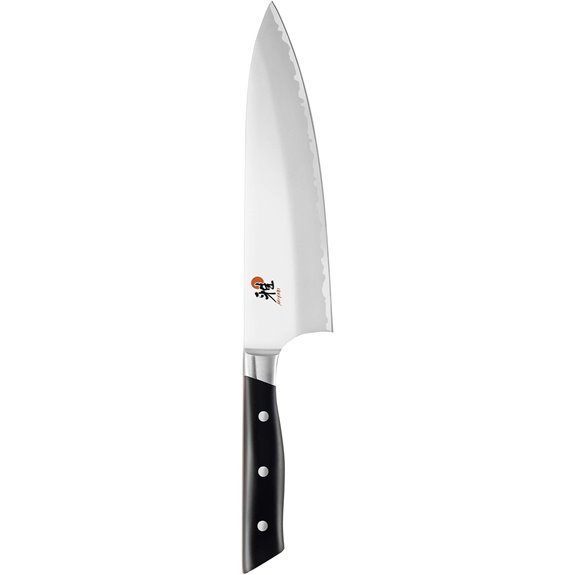
Miyabi Evolution Chef’s Knife 8″ Stainless Steel
The Miyabi Evolution 8″ Chef’s Knife hits that sweet spot I’ve been searching for: a blade that marries Japanese precision with German durability without making me choose sides.
Crafted in Seki, Japan, this knife takes 42 days and over 100 steps to create. That’s not marketing fluff! The FC61 fine carbide steel gets ice-hardened through Friodurx2, giving you exceptional edge retention and corrosion resistance.
The dry sharpening produces scalpel-like sharpness, and that mirror polish isn’t just pretty; it reduces friction.
Here’s what stands out:
- Authentic thin Japanese profile (8 inches)
- Ergonomic POM handle, triple-riveted for security
- Weighs 9.6 ounces balanced across 14 inches total length
- Handles both Western chopping and Asian rocking cuts
The polyoxymethylene handle feels secure even when I’m working fast. And no, don’t toss it in the dishwasher. Hand wash only.
The Evolution proves hybrid design works beautifully!
- Blade Steel:FC61 fine carbide steel
- Rockwell Hardness:Not specified (Friodurx2 ice-hardened)
- Sharpening Method:Dry sharpened
- Edge Angle:Not specified
- Origin:Seki, Japan
- Dishwasher Safe:No
- Additional Feature:German engineering blend
- Additional Feature:Triple-riveted POM handle
- Additional Feature:100+ step process
MIYABI Kaizen 7-inch Hollow Edge Rocking Santoku Knife
I reach for a santoku when I need a knife that bridges Western heft and Japanese precision, and the MIYABI Kaizen 7-inch Hollow Edge Rocking Santoku sits squarely in that sweet spot for home cooks ready to level up.
Here’s what makes this blade special:
- VG10 super steel core wrapped in 64 layers of flower Damascus, ice-hardened to Rockwell 60 through CRYODUR treatment
- 9.5 to 12 degree edge hand-honed via the three-step Honbazuke method (same technique used for samurai swords)
- Hollow ground blade creates air pockets so food releases cleanly, no more stuck potato slices
- Black linen Micarta handle with that traditional D-shape, moisture-repellent and grippy even when your hands are wet
At 7 inches and 9.6 ounces, it rocks beautifully through herbs and minces garlic without crushing. Handcrafted in Seki, Japan.
Not dishwasher safe, but honestly, you’ll want to hand-wash this one anyway.
Lifetime warranty against defects. ASIN B00QU8DDSC if you’re hunting.
- Blade Steel:VG10 super steel
- Rockwell Hardness:60
- Sharpening Method:Honbazuke (3-step)
- Edge Angle:9.5 to 12 degrees
- Origin:Seki, Japan
- Dishwasher Safe:No
- Additional Feature:Hollow edge design
- Additional Feature:Rocking Santoku style
- Additional Feature:Moisture-repellent handle
Miyabi Paring/Utility Knife Stainless Steel 5-inch
For cooks who need one blade that handles detail work and everyday utility, the Miyabi 5-inch Paring/Utility Knife stands out as the most versatile option in the 2026 lineup.
I’ve found this one particularly clever. That 5-inch length hits a sweet spot: longer than standard paring knives for slicing cheese or small produce, shorter than full utility blades for controlled coring and peeling.
The G2 micro-carbide powder steel core, wrapped in 100 layers of flower Damascus, creates a scalpel-like thin profile that takes and keeps an edge. Miyabi’s CRYODUR ice-hardening plus hand-honed Honbazuke sharpening to 9.5-12 degrees means serious cutting performance.
The Karelian Birch handle deserves mention. It’s the same wood Faberge used for imperial eggs, which feels appropriately luxurious for something handcrafted in Seki, Japan.
At 13.6 ounces with plain edge construction, it balances beautifully. Just remember: hand wash only. No dishwasher adventures for this one.
- Blade Steel:G2 micro-carbide powder steel
- Rockwell Hardness:Not specified
- Sharpening Method:Honbazuke (3-step)
- Edge Angle:9.5 to 12 degrees
- Origin:Seki, Japan
- Dishwasher Safe:No
- Additional Feature:5-inch utility blade
- Additional Feature:Versatile paring knife
- Additional Feature:G2 micro-carbide steel
MIYABI Mizu SG2 9.5″ Slicing Knife
If you’re after a slicing knife that handles roasts and briskets with real precision, this 9.5-inch blade from Miyabi’s Mizu line is where I’d point you.
Handcrafted in Seki, Japan, the Mizu SG2 brings serious metallurgy to your cutting board. The core is SG2 micro-carbide powder steel, wrapped in stainless and finished with that gorgeous hammered Tsuchime Damascus pattern.
Cryodur heat treatment pushes it to 63 Rockwell, so you’re getting excellent edge retention without the brittleness that plagues harder blades.
The Honbazuke sharpening method, borrowed from samurai sword tradition, gives you a wicked 12-degree double bevel edge. That’s three steps: two rounds on whetstones, then mirror polishing on leather.
The Micarta D-handle fits comfortably with its stainless bolster and decorative mosaic pin. At half a pound, it balances beautifully for long slicing sessions.
Hand wash only, lifetime warranty included.
- Blade Steel:SG2 micro-carbide powder stainless steel
- Rockwell Hardness:63
- Sharpening Method:Honbazuke (3-step)
- Edge Angle:12-degree double bevel
- Origin:Seki, Japan
- Dishwasher Safe:No
- Additional Feature:9.5-inch slicing blade
- Additional Feature:Straight Japanese style
- Additional Feature:Camping/travel recommended
Factors to Consider When Choosing Miyabi Knives
I want you to find a Miyabi that actually fits your hand and your cooking style, not just the one that looks prettiest on the block. When I’m helping someone choose, I always start with blade steel composition and handle material choice, then work through heat treatment method, edge geometry specs, and knife weight balance. These five elements determine whether you’ll reach for that knife every day or let it gather dust in the drawer!
Blade Steel Composition
When you’re trying to decide which Miyabi knife deserves a spot in your kitchen, the steel composition isn’t just technical jargon, it’s the heart of what makes these blades tick.
Miyabi offers three main core steels worth knowing:
- SG2 micro-carbide powder steel (~63 HRC): the hardest option, paired with stainless outer layers for serious edge retention
- FC61 fine carbide steel (~61 HRC): emphasizes durability through even carbide distribution
- VG10 super steel (~60 HRC): often wrapped in 64 or 65 layers of flower Damascus for balanced performance
And here’s the clever part: those pretty layered patterns aren’t just for show. The cladding protects the core. Whether it’s 48 layers or 100, the outer steel shields against corrosion while the core delivers sharpness.
You’ll get easier sharpening and longer-lasting edges without babysitting your blade.
Handle Material Choice
The blade steel might be doing the cutting, but I’m the one holding the handle for hours at a time, so this choice matters more than you’d think.
Here’s how I break it down:
- Micarta, my pick for durability. It’s moisture-resistant, gives me a confident grip, and feels stable through repeated chopping. The D-shape with bolster and metal end cap sits right in my palm.
- Karelian birchwood, when I want warmth and that natural feel. It’s the same wood used in Fabergé eggs, so it looks distinctive while still giving me Japanese-style control.
- Pakkawood, the practical middle ground. Good texture, classic D-shape, comfortable for slicing and rocking.
- Birch/birchwood pakkawood, for rustic grip with faceted styles, lightweight and ergonomic.
Match it to your habits. Rough kitchen? Micarta wins.
Heat Treatment Method
Look past the blade steel for a second, because how that steel gets hardened matters just as much as what’s in it. Miyabi’s ice-hardening methods, Cryodur and Friodur/Friodurx2, transform good steel into exceptional blades.
Here’s what each process brings:
Cryodur prioritizes corrosion resistance and long-lasting sharpness, ideal if you’re working with acidic ingredients daily.
Friodur/Friodurx2 pushes durability and edge retention harder, perfect for heavy prep sessions.
Both achieve roughly 60–63 HRC, that sweet spot where toughness meets wear resistance. And here’s the main point: identical steel families perform differently depending on treatment. A blade hardened with Cryodur won’t behave like its Friodurx2 cousin, even from the same lineup.
Edge Geometry Specs
Once you’ve got your steel and heat treatment sorted, it’s time to talk about how that blade actually meets your cutting board.
Miyabi specs their edge geometry as a double-bevel angle, typically landing between 9.5° and 12°. Here’s what that range means for you:
- 9.5°: razor-sharp aggression, delicate work
- 12°: the sweet spot for most home cooks, balancing bite with durability
Most Miyabi knives you’ll encounter sport that 12° double bevel, especially those finished with the Honbazuke method. That’s the traditional three-stone sharpening approach, and it’s doing the heavy lifting to maintain those precise angles.
And watch those listings! Some models quote a single fixed angle rather than a range. The lower number buys you surgical precision; the higher number buys you forgiveness. Pick your priority.
Knife Weight Balance
Beyond the blade’s sharpness, I’m convinced that weight and balance are what separate a knife you’ll reach for daily from one that languishes in the drawer. Miyabi’s range spans roughly 0.38 to 1.2 pounds, and that spread matters: Heftier blades feel planted, almost reassuring when you’re powering through squash, while lighter ones dance through herbs.
When I compare options, I always check the numbers together: length versus weight. Those 13.25–14.75 inch chef knives shift balance toward the handle, giving you power without wrist fatigue.
And don’t overlook the hardware! D-shaped handles with bolsters and metal end caps add purposeful weight right where you grip. Pakkawood feels anchored; micarta keeps things nimble. Match this to your cutting style, and you’re set.
Craft Origin Significance
The story behind a blade tells you almost as much as its edge. I always check where a Miyabi originates because that connection to tradition shapes everything about how it performs.
Japanese craft heritage matters. When you see Honbazuke sharpening mentioned, you’re looking at methods descended from sword-making traditions. That’s not marketing fluff. It’s three-stage hand-finishing that creates those scary-sharp bevels we chase.
Production in historic cutlery regions like Seki means:
- Artisan training that’s been refined over generations
- Standardized heat-treatment routines you can count on
- Thin blade profiles and controlled angles that actually cut differently
And consistent origin signals quality control. Same facility, same geometry standards, same finishing steps every time.
Clear labeling helps you understand what cultural influences shaped the knife. You’ll know if you’re getting Japanese construction philosophy or something diluted. Worth checking before you buy!